
Add Row
Add Element
Echo-Innovation Hub Logo
update
Eco-Innovation Hub
update
Add Element
  • Home
    • Categories
      • Plastic Waste Impact
      • Eco-Tech
      • Green Living
      • DIY Sustainability
      • Innovation Spotlight
      • Expert Insights
      • Product Reviews
      • Community Voices
    • Featured Business Profiles
    • All Posts
    • Eco-Tech
    • Green Living
    • DIY Sustainability
    • Innovation Spotlight
    • Expert Insights
    • Product Reviews
    • Plastic Waste Impact
    • Community Voices
    • Featured Business Profiles
    • Extra News
    October 19.2025
    3 Minutes Read

    Unveiling the E.O. Wilson Land Between the Rivers Preserve: Alabama's Hidden Wildlife Sanctuary

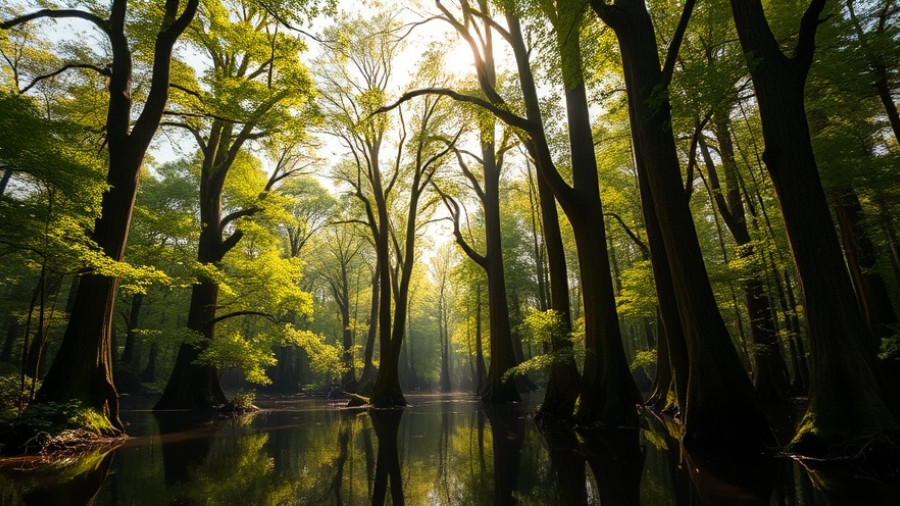
    E.O. Wilson Land Between the Rivers Preserve serene swamp with tall trees.

    Celebrating the E.O. Wilson Land Between the Rivers Preserve

    Deep in Clarke County, Alabama lies a hidden gem that embodies the beauty of nature and the spirit of conservation—the E.O. Wilson Land Between the Rivers Preserve. Named after the esteemed biologist and author E.O. Wilson, this new preserve spans nearly 8,000 acres of vital wetlands, swamps, and forests, showcasing a breathtaking ecosystem that has captivated hearts and minds for generations.

    A Historied Landscape of Natural Wonder

    Once described as ‘America’s Amazon,’ the Mobile-Tensaw Delta, where the preserve is located, holds a significant place not only in Alabama’s geography but also in its cultural heritage. This delta, which juxtaposes the confluence of the Tombigbee and Alabama Rivers, has long been nurtured by the waters that surround it. The wetlands serve as critical habitats for numerous endangered species, via their intricate networks of biodiversity. Historically, these lands were home to the Naniaba people, serving as a vital meeting point long before the arrival of European settlers.

    Preservation Efforts and Environmental Significance

    The Nature Conservancy, along with the E.O. Wilson Biodiversity Foundation, spearheaded the preservation effort, purchasing the land thanks to donations from community benefactors including Patagonia’s Holdfast Collective. This initiative underscores the vital role of grassroots funding in conservation. The decision to protect this expanse ensures ongoing support for an ecosystem that houses species like the Alabama sturgeon and Delta sawbacks, amidst others that play a critical role in maintaining ecological balance.

    The Legacy of E.O. Wilson

    E.O. Wilson, whose career was deeply intertwined with the very environment he sought to protect, remains an enduring figure in environmental advocacy. His profound insights on biodiversity have shaped not just scientific discourse but also conservation policies worldwide. The establishment of this nature preserve is a direct tribute to Wilson’s fervent belief in the necessity to protect half of the Earth’s habitats to combat the imminent extinction crisis—a vision he eloquently presented in his book “Half-Earth: Our Planet’s Fight for Life.”

    Experiencing Nature at the Preserve

    Visitors to the E.O. Wilson Preserve can expect a genuine return to nature, where the hum of insects and songs of birds fill the air. As Mitch Reid, state director for TNC in Alabama, described after a boat tour through the wetlands, the sensory experience evokes memories of ‘old Alabama’—a serene retreat from the chaos of modernity, reminiscent of a place where time seems to stand still. Birdwatchers, nature enthusiasts, and families alike can find fulfillment in this untouched, natural expanse, offering scenic trails that reveal the splendor of Alabama's wilderness.

    Cultivating Community Awareness and Involvement

    This preserve is not just a refuge for wildlife; it serves as an educational resource for communities interested in conservation and biodiversity. Upcoming events will focus on engagement between the local community and the science of environmental protection, fostering a culture that prioritizes nature-centric initiatives. Such collaborative efforts promise to inspire a sense of stewardship toward these vital ecosystems among residents and visitors alike.

    Conclusion: A Call to Preserve Our Natural Heritage

    The dedication of the E.O. Wilson Land Between the Rivers Preserve exemplifies the power of community-driven efforts in conservation. It stands as a reminder of the collective responsibility we share in protecting our planet's fragile ecosystems for generations to come. As more individuals and organizations unite in their mission for environmental preservation, we can foster a world that celebrates and nurtures its natural heritage. It is our duty to ensure that places like the E.O. Wilson Preserve continue to thrive, echoing Wilson’s legacy of hope and conservation.

    Expert Insights

    7 Views

    0 Comments

    Write A Comment

    *
    *
    Please complete the captcha to submit your comment.
    Related Posts All Posts
    04.10.2026

    Why Tungsten Scrap Export Controls Could Transform the Industry Landscape

    Update Understanding the Urgency Behind Tungsten Scrap Export Controls The debate surrounding tungsten scrap export controls has intensified, with various industries rallying for action. As the U.S. seeks to fortify its supply chain and maintain a competitive edge, the potential restrictions on tungsten scrap are coming to the forefront of national discussion. Many stakeholders argue that controlling how tungsten is exported, especially to adversarial nations like China and Russia, is crucial to securing domestic supplies. This has become even more critical considering that tungsten is classified among the final 2025 U.S. List of Critical Minerals—a list aimed at emphasizing materials that are vital to the economy and national security. China's Influence on the Global Tungsten Market China's grip on the tungsten market cannot be overstated. With more than 80% of the global tungsten supply originating from Chinese mines, export controls initiated by Beijing have left a profound impact on the entire industry. Earlier this year, China imposed tighter restrictions on the export of tungsten, prompting concerns across the globe about shortages and increased prices. In response, many Western industries—particularly in semiconductor manufacturing—are beginning to diversify their supply chains.' The Ripple Effect on Domestic Industries The proposed export controls intend to support U.S. manufacturers and bolster domestic processing capabilities. However, the reality is complex. Even if more tungsten scrap stays within the United States, existing domestic facilities may lack the immediate capacity to handle increased supply effectively. According to the U.S. Geological Survey (USGS), there are only seven companies that can refine tungsten into usable products, such as tungsten carbide powder or metal powders. If these companies cannot absorb the newly available material, prices could actually fall, indicating that demand and supply dynamics are more nuanced than they might appear. Future Predictions: What Lies Ahead for Tungsten Supply? Looking toward the future, the actual implementation of these controls will hinge on how the U.S. Department of Commerce defines tungsten scrap. A narrower definition may focus solely on high-purity materials, while a broader definition could encompass mixed scrapped materials, further complicating recovery operations for recyclers and processors. Additionally, industry insiders note that there are strategies underway to support alternative tungsten supply sources, including mining initiatives in South Korea and Canada, but these will take years to realize. Tungsten in Semiconductor Manufacturing: A Critical Link One of the industries feeling the most pressure from the tungsten supply chain constraints is semiconductor manufacturing. Tungsten plays an essential role in producing semiconductor materials, specifically in its gaseous form as tungsten hexafluoride (WF₆). The introduction of export controls has raised alarms in this sector, as semiconductor manufacturers rely on timely and sufficient access to high-quality tungsten to maintain production lines. Strategies and Opportunities for Resilience To combat the looming supply issues, companies and governments are actively exploring various tactics to strengthen their tungsten supply chains. Key initiatives include investment in recycling technology and closed-loop recovery methods, as well as establishing strategic partnerships with non-Chinese suppliers to develop alternative mining sites. While immediate solutions are critical, cultivating sustainable supply chains requires concerted effort and innovative thinking over the long term. Conclusion: Staying Ahead in a Volatile Market The discussions around tungsten scrap export controls signify broader concerns about supply chain security in an increasingly geopolitical landscape. Industries that depend on tungsten must engage with policymakers, strategize for resilient supply chains, and invest in emerging technologies to secure their futures. As demand for critical minerals rises, the conversation around tungsten will be pivotal not just for the U.S., but for global markets as well.

    04.10.2026

    Reimagining Our Relationship with Nature to Meet Climate Targets

    Update The Urgent Need for a New Relationship with Nature The latest research urges humanity to redefine its relationship with the natural world if we’re to meet climate targets. A recent study published in Frontiers in Science emphasizes that reversing ecological damage and enhancing biodiversity must be central to tackling climate change. As lead author Harvey Locke explains, society often views nature merely as a resource for consumption, overlooking its critical role in sustaining life and maintaining industry. This established view risks not just our environment but the very economy that supports us. Lessons from Yellowstone to Yukon As a powerful case study, the Yellowstone to Yukon (Y2Y) region illustrates how sustainable practices can coexist with economic growth. Home to one of the largest intact temperate ecosystems, it houses a diversity of wildlife, including bears, wolves, and bison, which’ve shown remarkable recovery. According to Locke, this growth has been possible because of a cultural shift that values nature and its importance to future well-being. Addressing Current Environmental Threats However, the burgeoning human settlement in the region poses risks as people expand into natural habitats, increasing the likelihood of wildfires and habitat disruptions. The rise in wildlife populations sometimes meets resistance from local communities, illustrating the complex balance needed to foster human and environmental coexistence. As Locke warns, improper growth threatens to “kill the goose that’s laying the golden egg,” urging a cautious approach. A Global Call to Action To achieve climate goals, the study advocates for a shift toward a “Nature Positive” approach, wherein society not only halts biodiversity loss but also actively works to restore ecosystems by 2030. If this goal is to be achieved, significant policy changes, investments in habitat restoration, and education about coexistence strategies are essential. Inspiring Change Through Community—A Local Perspective Locally, various grassroots initiatives reflect this necessary shift. Communities across the planet are banding together to restore local habitats and promote policies protecting biodiversity. These efforts symbolize a broader societal acknowledgment that humanity is part of a greater ecosystem. Emphasizing this interconnectedness could inspire countless individuals to foster similar initiatives in their neighborhoods, ultimately driving the change needed on a global scale. By valuing our environment and understanding its vital role in our survival, we can encourage healthier economies and a vibrant planet for future generations. As we strive to meet our climate targets, let us recognize the profound interdependence between humanity and nature.

    04.10.2026

    Is the Keystone XL Pipeline Resurrection a Threat to Environmental Safety?

    Update What's Happening with the Keystone XL Pipeline? The Keystone XL pipeline may be experiencing a resurrection, albeit in a new form. Originally proposed in 2008 to transport Canadian oil to the U.S. Gulf Coast, the project has faced a tumultuous journey through U.S. politics. After being halted by President Obama, revived by Trump, and subsequently canceled again by Biden, it appears that a revised version is on the table thanks to Bridger Pipeline LLC. New Proposal in the Works The new proposal seeks to build a 647-mile pipeline starting at the Canadian border and extending through Montana and into Wyoming. According to Bridger, the pipeline could transport up to 550,000 barrels of crude oil a day, with the potential capacity to double that amount. However, critics argue that this pipeline may simply be a “bait and switch” tactic, meant to circumvent the environmental opposition that halted the original Keystone XL. Environmental Concerns Remain Environmental advocates are wary of this development, citing that the proposed route overlaps with that of the original Keystone XL. Jane Kleeb, founder of Bold Alliance, points out that breaking up pipeline projects into smaller, less scrutinized sections helps companies avoid opposition. This raises concerns about the transparency of such projects and their potential impacts on communities and ecosystems along the route. The Bigger Picture: Tar Sands and Climate Impact While Bridger Pipeline refrains from explicitly labeling the transported oil as coming from Canada’s tar sands, experts stress that this is indeed the source. Tar sands oil extraction is notorious for its detrimental environmental consequences, which include high greenhouse gas emissions and substantial water pollution risks from extraction methods. How You Can Get Involved The Bureau of Land Management is currently accepting public comments on the Bridger Pipeline proposal until May 1. It’s crucial for citizens who care about environmental and community implications to make their voices heard. Participating in public meetings and submitting feedback can influence how this project is handled moving forward. Conclusion The proposed Bridger pipeline signifies a new chapter in the ongoing saga of oil infrastructure projects in the U.S. While it aims to bring Canadian oil to American markets, the environmental impacts and community concerns raise questions about sustainability and accountability. Getting involved in this discussion is vital for anyone who wants to safeguard our natural resources.

    Terms of Service

    Privacy Policy

    Core Modal Title

    Sorry, no results found

    You Might Find These Articles Interesting

    T
    Please Check Your Email
    We Will Be Following Up Shortly
    *
    *
    *